
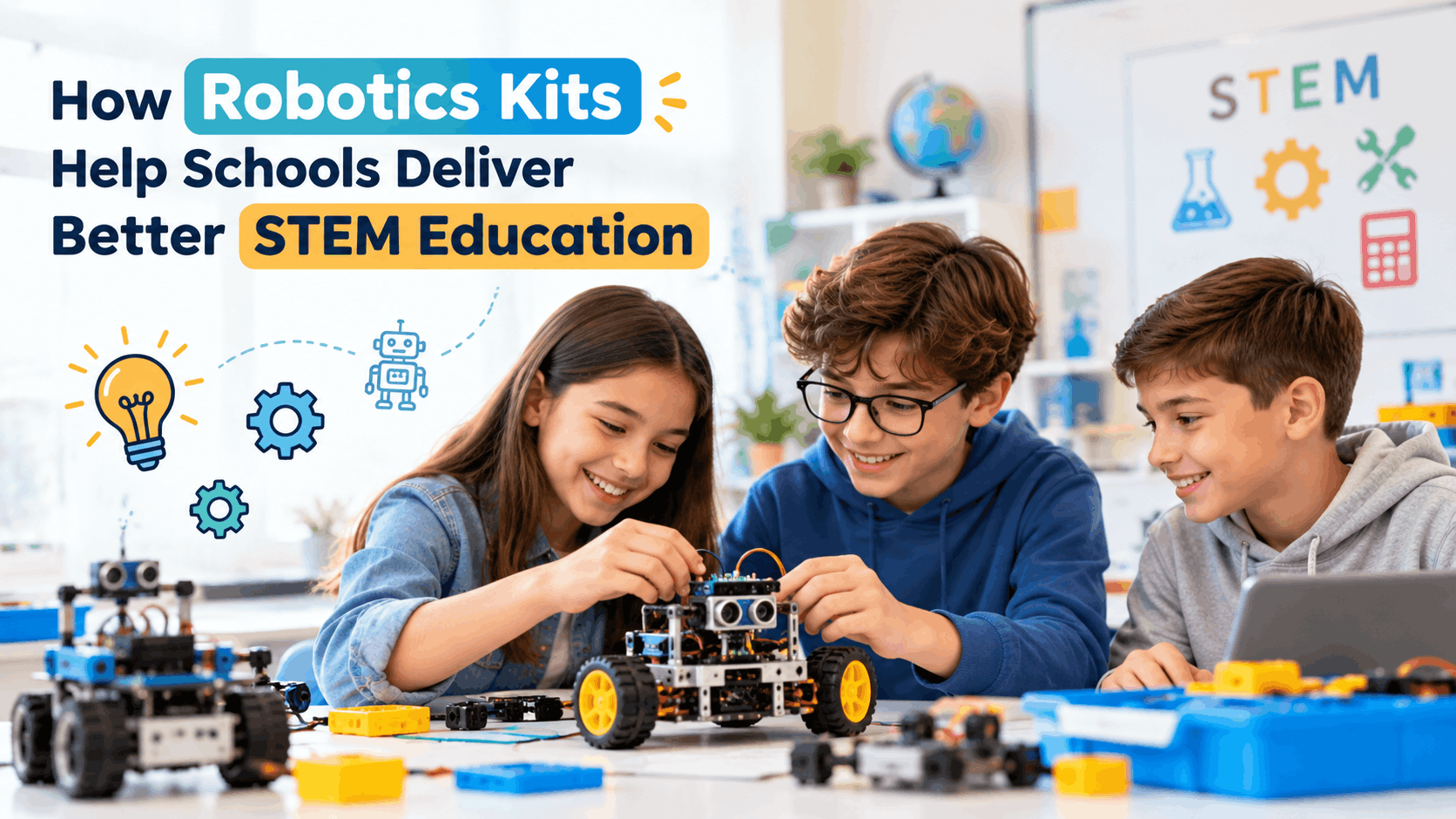
Introduction: Turning STEM Learning Into Real-World Experience
STEM education is most effective when students can do more than simply read about science, technology, engineering, and mathematics. Modern classrooms need learning experiences that encourage students to experiment, solve problems, collaborate, and understand how concepts work in real life. Robotics Kits provide an engaging way for schools to bring these principles into the classroom by combining hands-on building with coding, engineering, electronics, and creative problem-solving.
With the right technology and guidance, Robotics Kits for Schools can transform traditional lessons into interactive learning experiences. Students can build robots, program movements, test different designs, identify mistakes, and improve their projects. This practical approach makes STEM subjects more exciting while helping learners develop skills that can support their academic and professional futures.
Making STEM Learning More Practical
One of the biggest advantages of robotics is its ability to connect classroom theory with practical applications. Students may learn mathematical calculations, programming concepts, circuits, sensors, or mechanical principles separately, but robotics brings these subjects together in one project.
For example, a student building a line-following robot may need to understand sensors, programming logic, motor control, and basic mathematics. Instead of learning each concept in isolation, students see how different STEM disciplines work together to solve a specific challenge.
This makes learning more meaningful. When students immediately see the result of their work, they can better understand why a particular concept matters and how it can be applied outside the classroom.
Robotics Kits for Schools Encourage Problem-Solving
Problem-solving is one of the most important skills students can develop through STEM education. Robotics naturally creates opportunities for students to think critically and find solutions.
A robot may not move as expected, a sensor may produce incorrect results, or a program may contain an error. Instead of simply receiving the correct answer from a teacher, students can investigate what went wrong and test possible solutions.
This process encourages a growth mindset. Failure becomes part of learning rather than something students should fear. Each unsuccessful attempt provides information that can help students improve their design.
By regularly working on robotics challenges, students learn to break complex problems into smaller steps, analyze possible solutions, test ideas, and make improvements based on results.
Building Coding and Technology Skills
Coding is becoming an increasingly valuable skill across many industries. Robotics provides a practical environment where students can learn programming concepts while creating something tangible.
Through Robotics Kits for Schools, students can explore concepts such as sequences, loops, conditions, variables, commands, and logical thinking. Instead of learning programming only through theoretical exercises, students can write code and immediately see how it changes the behavior of a robot.
This immediate feedback can make coding less intimidating, especially for beginners. Students can experiment with different commands, observe the results, and gradually develop confidence in programming.
STEM Kits for Kids Make Learning Engaging
Engagement plays an important role in effective education. Traditional lectures may not appeal equally to every learner, but interactive projects can encourage students to participate actively.
STEM Kits for Kids can introduce age-appropriate activities involving robotics, electronics, mechanics, coding, and engineering. Students can work individually or in teams to complete challenges, build models, and create their own inventions.
The hands-on nature of these kits can also support different learning styles. Students who enjoy building can focus on mechanical elements, while those interested in technology can explore coding and electronics. This flexibility allows multiple students to contribute their strengths to the same project.
Supporting Collaborative Classroom Learning
Robotics projects can also encourage teamwork. Schools can organize students into small groups and assign different responsibilities, such as designing, building, coding, testing, and documenting the project.
Students learn how to communicate ideas, listen to teammates, manage responsibilities, and work toward a shared objective. They also discover that successful engineering projects often require multiple perspectives.
For teachers, robotics can therefore become more than a technology activity. It can be a tool for developing communication, leadership, creativity, and collaboration alongside technical knowledge.
Connecting Robotics With STEM Education Programs
Schools can integrate robotics into broader STEM Education Programs rather than treating it as a one-time activity. A structured program can gradually introduce students to increasingly advanced concepts.
Younger learners might begin with simple construction and movement activities. As their knowledge develops, they can progress toward sensors, electronics, programming, automation, artificial intelligence, and advanced robotics challenges.
This progressive approach helps students build knowledge step by step. It also gives them opportunities to revisit previously learned concepts and apply them in more complex projects.
Platforms such as Robitro can support this type of learning journey by combining robotics and technology education with structured learning opportunities for young innovators.
Preparing Students for Future Careers
The skills developed through robotics are relevant to many modern career fields, including engineering, software development, automation, electronics, artificial intelligence, and technology.
However, the value of robotics education goes beyond preparing students for a specific profession. It helps develop transferable abilities such as logical thinking, creativity, experimentation, communication, and persistence.
Students who regularly participate in robotics projects can become more comfortable with exploring unfamiliar problems and developing their own solutions. These qualities can benefit them across education and future careers.
How Schools Can Get More From Robotics Kits
To maximize the benefits of robotics, schools should focus on structured, challenge-based learning rather than simply allowing students to assemble a robot. Teachers can introduce a concept, demonstrate an example, and then provide students with a challenge to solve.
Projects can become progressively more difficult as students develop confidence. Schools can also organize robotics competitions, innovation days, team challenges, and project presentations to make learning more exciting.
Teacher training is equally important. Educators should understand how the kits work and how robotics activities can connect with existing science, mathematics, technology, and engineering lessons.
Conclusion: Building the Classroom of Tomorrow
Robotics Kits can turn STEM education from a primarily theoretical experience into an active journey of discovery. By building, coding, testing, and improving robots, students gain practical experience while developing creativity, critical thinking, collaboration, and problem-solving skills.
For schools looking to strengthen their STEM Education Programs, investing in Robotics Kits for Schools and STEM Kits for Kids can provide students with meaningful opportunities to explore technology. With structured learning and platforms such as Robitro, schools can help young learners move from simply consuming technology to understanding, creating, and innovating with it.
Frequently Asked Questions
1. What are Robotics Kits for Schools?
Robotics Kits for Schools are educational kits designed to help students learn robotics, coding, electronics, engineering, and problem-solving through practical projects and hands-on activities.
2. How do Robotics Kits support STEM education?
Robotics Kits combine multiple STEM disciplines in practical projects. Students can apply mathematics, science, engineering, electronics, and programming concepts while designing and controlling robots.
3. Are STEM Kits for Kids suitable for beginners?
Yes. STEM Kits for Kids can be selected according to students’ ages and skill levels. Beginner-friendly kits can introduce basic construction, electronics, coding, and problem-solving before progressing to advanced concepts.
4. Can schools use robotics as part of STEM Education Programs?
Absolutely. Robotics can be integrated into STEM Education Programs through classroom lessons, after-school clubs, workshops, competitions, and project-based learning activities.
5. What is Robitro?
Robitro is a learning platform focused on helping young learners explore robotics, coding, and STEM-related technology through structured educational experiences and practical learning opportunities.